Deer Fawns – If You Find a Baby Deer….. (Updated: January 2017)
When I originally wrote the article “A Year in the Life of …. White-tailed
Deer - Spring” most people found it to be an enjoyable and informative. Yet, one of our
long time deer feeder customers, Angela from Colorado who has an extremely successful feeding
station, wrote and added a very important note. Angela suggested I talk about Fawns and how
people find them “abandoned” by the Doe and felt I should address this point.
Angela had a great point and I wish to expand on her thought here.
She hid her calf so well it took us three days to find it and only did so by following mom at a
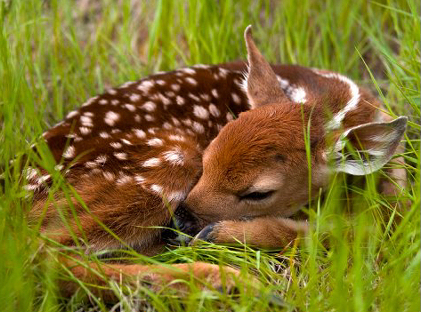
great distance. Doe deer typically hide their fawns this well but occasionally, the tired fawn will simply
lay down and sleep, just like a human baby. Hence the reason people find fawns in their gardens,
at the lawn's edge, on a hiking trail or even on their back stoop, etc…
Why do Does and Fawns do this? Baby deer are no different than any other baby mammal.
They are too small, too weak, and too fragile to move efficiently on their own. Since mom does not
have the ability to hoist her baby into her arms or onto her back, the fawn must be left in a safe location
as the Doe feeds. This practice will only happen for a week or so as her fawn(s) gain strength
and agility. Once the babies can keep up with mom, they will travel together.
This is when the Does will START bringing their babies to your feeders.
This also brings up a fun point. If you watch your Doe Deer closely, she/they will
depart from her normal day-to-day visits and disappear for a few days. She is off birthing her
young and soon you will see your Does coming back to your feeders yet have no babies in tow. This is
because they have tucked their young away and are refueling through your feed offering. Keep your
feeders filled and within a week or two, the babies will arrive.... and this is a HUGE treat!
More importantly, a newborn fawn has little to no natural scent as a protective
measure from predators. Handle the baby and your scent is now an attractant.
In all my years of interacting with nature, only once had I handled a fawn in the wild.
I was driving home from work one evening and came upon a baby in the middle of the road.
As my car roared toward it, it dropped to the road and laid perfectly still and flat with it's chin on
the centerline. Obviously, I stopped the car and thought about what to do. The fawn would not
move, even flinch. It was in its protective mode of laying still. It was imperative the fawn needed to
be moved yet I was very apprehensive in regards to "MOM". I actually feared stepping out of the car
but it was mandatory I move the fawn. So I did. But I got out of the car with an eye to the surrounding
woods, fields, etc... I was watching for the Doe as I approached her baby. No mother showed up
so I carefully approached her baby and scooped it up, one hand under its chest, the other
under its hind quarters. Surprisingly, the fawn had no fear of me. It did not bleat, did not
try to get away. Matter of fact, it stretched out its legs, raised it head and erected its
ears as if it were enjoying the ride. I quickly carried it off into the nearby woods
way off the road. Yet, my eyes and ears kept vigilant to the prospect of Mom
but she never showed. To this day, this episode is consider
one of my greatest wildlife moments ever.
Secondly, depart the area quickly to gain good distance from the baby.
The Doe’s protective instinct is a very formidable defense mechanism and she WILL
ATTACT YOU if she feels her baby is in danger, hence my apprehension in the above story.
You may not see her nearby but the chances are excellent she is within earshot or eyesight of her young.
If you begin messing with her baby, the chances of you getting hurt or worse escalates tremendously.
If you disturb her young enough to make it cry out in fear, be very weary of a charging mother
as she WILL NOT hesitate to protect her baby and she WILL hurt you or worse.
With all that said. Keep in mind the near future of Does bringing their Fawns
to your deer feeders. Place the feeders at the back part of your property, away from
areas people and pets frequent and then enjoy the babies at a distance. DO NOT try to
play with them, DO NOT try to pet them, DO NOT try to interact in any way. The idea of feeding
deer, or any other wild creature, is to offer them food in exchange for the VIEW, not the interaction.
Mother deer (Mother anything actually) are protective, just like us humans. If someone were
to endanger my children, I will beat them to a pulp….. and so would you and so will
wild animals. Enjoy the view of your baby deer from a distance, watch the Does
and others in an effort to learn more about our ever-loved nature guests and
be completely satisfied with the blessings you have received. When
done correctly and safely, feeding wildlife is a meaningful hobby filled
with joy, wonder, education and enrichment to our own lives.
I Wish You a Great Day!
Enjoy Your WIldlife,
Peter Hurley
Owner: Hurley-Byrd
Disclaimer and Rights: Use of any and all Hurley-Byrd products and the compliance of any and all local, state or federal laws is strictly the responsibility of the user of our products and Hurley-Byrd assumes no responsibility or liability in the use of said items and by using any Hurley-Byrd product the user accepts any and all responsibilities and liabilities in regard to the law, the personal safety and welfare of any and all person(s), wild or domestic animal(s), personal property belonging to the user or any other individual, organization or entity whom the attraction of any person(s), wild or domestic animal(s) that the product and or its contents may cause.
All rights regarding product designs, innovations and any intellectual property are reserved by Hurley-Byrd, LLC © 2016
Shop by:
Feeder Style
Installation
Miscellaneous
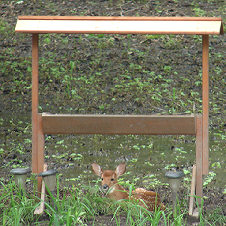
VERY rarely are deer fawns ever abandoned by the Doe.
We receive a lot of calls and emails this time of year from
people who have found a fawn with no mother nearby. This
happens all the time as Doe deer will set their babies in a safe
place in order to forage for much needed sustenance. This is a
normal, natural practice which has played out for millennia by
bovines and will continue. The Doe has NOT abandoned her
fawn. She is simply off refueling herself so she and her babies
can continue to live and thrive. As a young farm boy... WAY
back in the day... I remember one of our cows birthing her
calf while out to pasture. She then hid her calf and would
come back to the barn for milking and food.
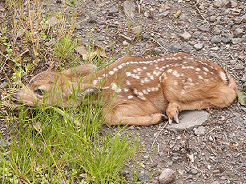
Back to the point:
What to do if you find an “abandoned” fawn?
As mentioned, it is highly unlikely the fawn
is actually abandoned. The most likely scenario is
the fact noted above. If you stumble upon a fawn, or it
stumbles upon you, LEAVE IT ALONE. The fawn is NOT
lost, the doe has NOT abandoned her offspring and it
is NOT very probable the doe has died. Enjoy the
beauty of the fawn as the gift you have received
and depart quickly leaving as little scent as possible
in the area. DO NOT handle the newborn as it
is like any other mammalian baby with low
defenses to diseases, germs, etc…
Deer Feeding Gifts: When you send deer feeder as gift you send two gifts: the feeders themselves, and the moment they arrive.
There's the knock at the door or the package on the porch. And the next thing that happens is your special someone's
heart races with delight as they open a gift they will remember for years to come.
Feeder Delivery: Hurley-Byrd does it differently and oversees every part of the process: from the buying of raw materials, to handcrafting the feeder, to the day your purchase arrives at the front door. We send freshly crafted feeders direct and bypass all the middlemen, which means better feeders and a better value. (Don't just take our word for it. Thousands of customers rate Hurley-Byrd "best value.") We trust in complete satisfaction and lasting value, too, which is why we guarantee a perfect feeder for you or your recipient , and also that your feeders will outlast all others available and will be enjoyed from the moment they arrive and for years to come. It's how Hurley-Byrd is changing how America feeds their wildlife.
Hurley-Byrd does it differently: We handcraft every feeder we sell. Beginning with our own designs, buying the finest western red cedar and crafting your feeders
to near perfection with a beautiful penetrating oil finish so they last for years. We take pride in every step of our service, too. From the moment you first interact with us, whether on our website or on the phone, to the delivery of your feeders and gifts and everything in between. We want to make owning and gift giving easy for you. So whether it's a simple thank you, a unique deer feeder or a whole feeding station for yourself, choose Hurley-Byrd and see what a difference our feeders really make.
All Rights within this web site and its related products are Copyrighted and Reserved by:
Hurley-Byrd, LLC
462 Williams Crossroads Way
Fairmont, West Virginia 26554
Toll free: 877-363-0199
© 2002 - 2019
Shop by:




Hurley Byrd's Festival of Feeders
Pick Your Exact Feeder Exclusively on eBay